



When parents separate, the first big question is usually about the children: where will they live and how will they spend time with each parent? In the UK, parents are encouraged to agree child arrangements themselves. If they cannot, the Family Court decides, always putting the child’s welfare first. This guide explains how each route works and what the court looks at. It is general information rather than legal advice. Scotland and Northern Ireland follow different rules.
What Are Child Arrangements?
Child arrangements are the practical plans for a child’s life when their parents live apart. They cover where the child lives most of the time, when they spend time with the other parent and how they stay in touch between visits.
There is no standard pattern. One family might choose a week-on, week-off routine. Another might have a child live mainly with one parent and stay with the other on alternate weekends plus one midweek dinner. The right choice depends on the child’s age, school and needs.
How Are Child Arrangements Decided?
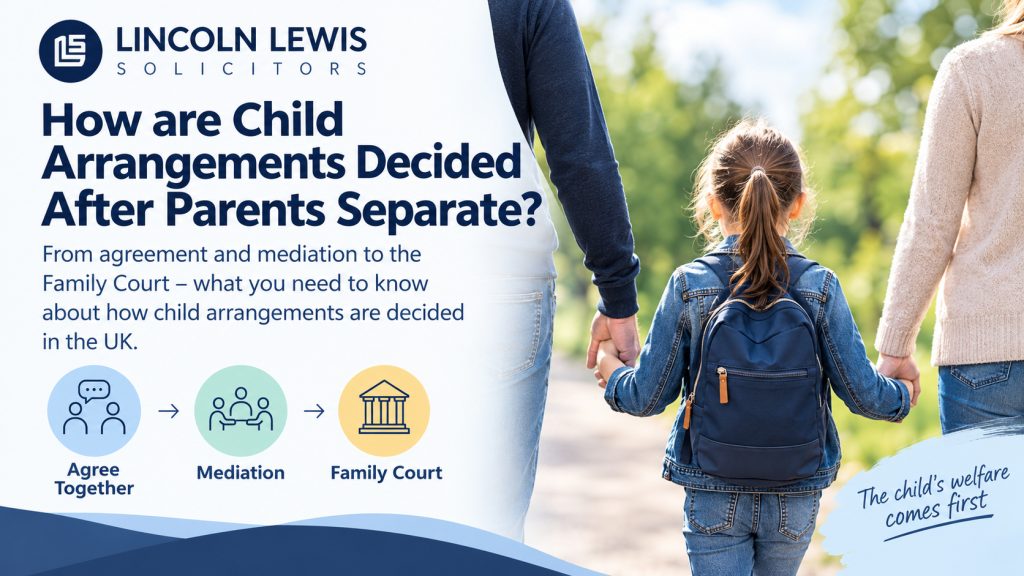
There are three main routes. Most families start with the first.
1. Agreeing Between Yourselves
Many separating parents work out arrangements without involving anyone else. If you can talk calmly about the children’s needs, this is usually the quickest, cheapest and least stressful option.
Take Hannah and Dev, who live ten minutes apart with a seven-year-old daughter. They agree she will stay with Hannah during the school week and with Dev on alternate weekends plus Wednesday evenings. They write this down in a simple parenting plan and review it each term.
A parenting plan is not legally binding, but it gives both parents a clear record. If you want the agreement to carry legal weight, you can ask the court to approve it as a consent order.
2. Mediation and Other Out-of-Court Options
If you cannot agree alone, a family mediator can help. Mediation is a series of meetings where a trained, neutral person helps you both reach your own agreement. The mediator does not take sides or make decisions for you.
Wondering how to agree arrangements without going to court? A Mediation Information and Assessment Meeting (MIAM) is usually the easiest place to start. At a MIAM, a mediator explains your options and checks whether mediation suits your situation. Before applying to court, you must normally attend one. Exemptions apply in situations such as domestic abuse, child protection concerns and urgent cases.
3. Asking the Family Court to Decide
If nothing else works, either parent can apply to the Family Court for a child arrangements order. This is a legal order setting out where a child lives, who they spend time with and when. The process usually runs like this:
- You apply to the Family Court online or using Form C100. A fee applies unless you qualify for help with fees.
- Cafcass (the Children and Family Court Advisory and Support Service) carries out safeguarding checks and gathers information before the first hearing.
- At the first hearing, the court explores whether agreement is possible.
- The court may order a report on the child’s circumstances and wishes. If abuse is alleged, it may hold a fact-finding hearing.
- If there is still no agreement, a final hearing takes place and the judge or magistrates decide.
Cases can take many months, so exploring other routes first is usually wise. The court can also make a specific issue order to settle one decision such as choice of school. A prohibited steps order can stop something happening, such as taking a child abroad.
What Does the Court Consider?
The guiding rule is the welfare principle. The child’s welfare is the court’s paramount consideration, which means it outranks the wishes or convenience of either parent. Judges and magistrates work through the welfare checklist in the Children Act 1989, which covers:
- the child’s wishes and feelings, in light of their age and understanding
- their physical, emotional and educational needs
- the likely effect of any change in their circumstances
- their age, background and any relevant characteristics
- any harm they have suffered or are at risk of suffering
- how capable each parent is of meeting their needs
- the range of orders the court can make
The law also currently presumes that involving both parents will further a child’s welfare unless the evidence shows otherwise. That presumption does not apply where a parent’s involvement would put the child at risk. The government has announced plans to repeal it through the Courts and Tribunals Bill. Until that becomes law, the presumption stays in force.
Will the Court Order a 50/50 Split?
Not automatically. The court looks at each child’s circumstances rather than starting from equal time. A baby or toddler may do best with shorter, more frequent visits. A teenager may need a flexible routine that fits school, friends and hobbies.
Do Children Get a Say?
Yes, but they do not make the decision. There is no fixed age at which a child can choose where to live. The court considers a child’s wishes and feelings in light of their age and understanding. Older children’s views usually carry more weight, yet the court is not bound by them.
What If There Are Safety Concerns?
If domestic abuse or a risk to the child is involved, tell the court and Cafcass as early as possible. The court can put protective measures in place, such as supervised contact at a contact centre or indirect contact by letter. In some cases, it may decide that direct contact should not take place.
Frequently Asked Questions About Child Arrangements
What Is a Child Arrangements Order?
It is a legal order from the Family Court that sets out where a child lives, who they spend time with and when. The court only makes one if it believes doing so is better for the child than making no order.
Do I Have to Go to Court to Decide Child Arrangements?
No. Many parents agree arrangements themselves or through mediation. You only need the court if you cannot agree or want a formal order.
Do Mothers Automatically Get Custody?
No. Courts in England and Wales no longer use the word custody and do not favour either parent because of their gender. They focus on what is best for the child.
Can Child Arrangements Be Changed Later?
Yes. Parents can agree changes at any time. If a court order exists and you disagree, either parent can apply to change it.
Do Both Parents Have a Say in Major Decisions?
Parents with parental responsibility share the right to be involved in decisions such as schooling and medical treatment. Separation does not remove it.
Conclusion
Child arrangements are decided through agreement first, mediation second and the Family Court as a last resort. Whichever route you take, the aim is the same: a plan that puts the child’s welfare first. Keep the focus on your child’s routine and needs, write arrangements down and review them as your child grows. If you are unsure where you stand, a family solicitor or mediator can help you choose your next step.